Friday, April 3, 2015

The Difference A Year Can Make


The Difference A Year Can Make [INFOGRAPHIC] | Keeping Current Matters

Some Important Points To Consider:

  • The latest Freddie Mac Primary Mortgage Market Survey reports the 30-year fixed rate at 3.7%.
  • Freddie Mac's projection for Q2 2016 is that the rate will be 4.7% (a full percentage point higher)
  • The Home Price Expectation Survey predicts that home prices will appreciate by 4.4% during this same time

The impact waiting a year to purchase your dream home can make on your monthly payment is significant. Contact a local real estate professional today to discuss your options before the experts' predictions become reality!

Friday, March 27, 2015

Housing Inventory Slowly Disappearing


The price of any item is determined by the supply of that item, and the market demand. The National
Association of Realtors (NAR) released their latest Existing Home Sales Report this week.

Inventory Levels & Demand

Amidst reporting on the fact that sales of existing homes rose 1.2% from January, and outpaced year-over-year figures for the fifth consecutive month, was the news that total unsold housing inventory is at 4.6-month supply.
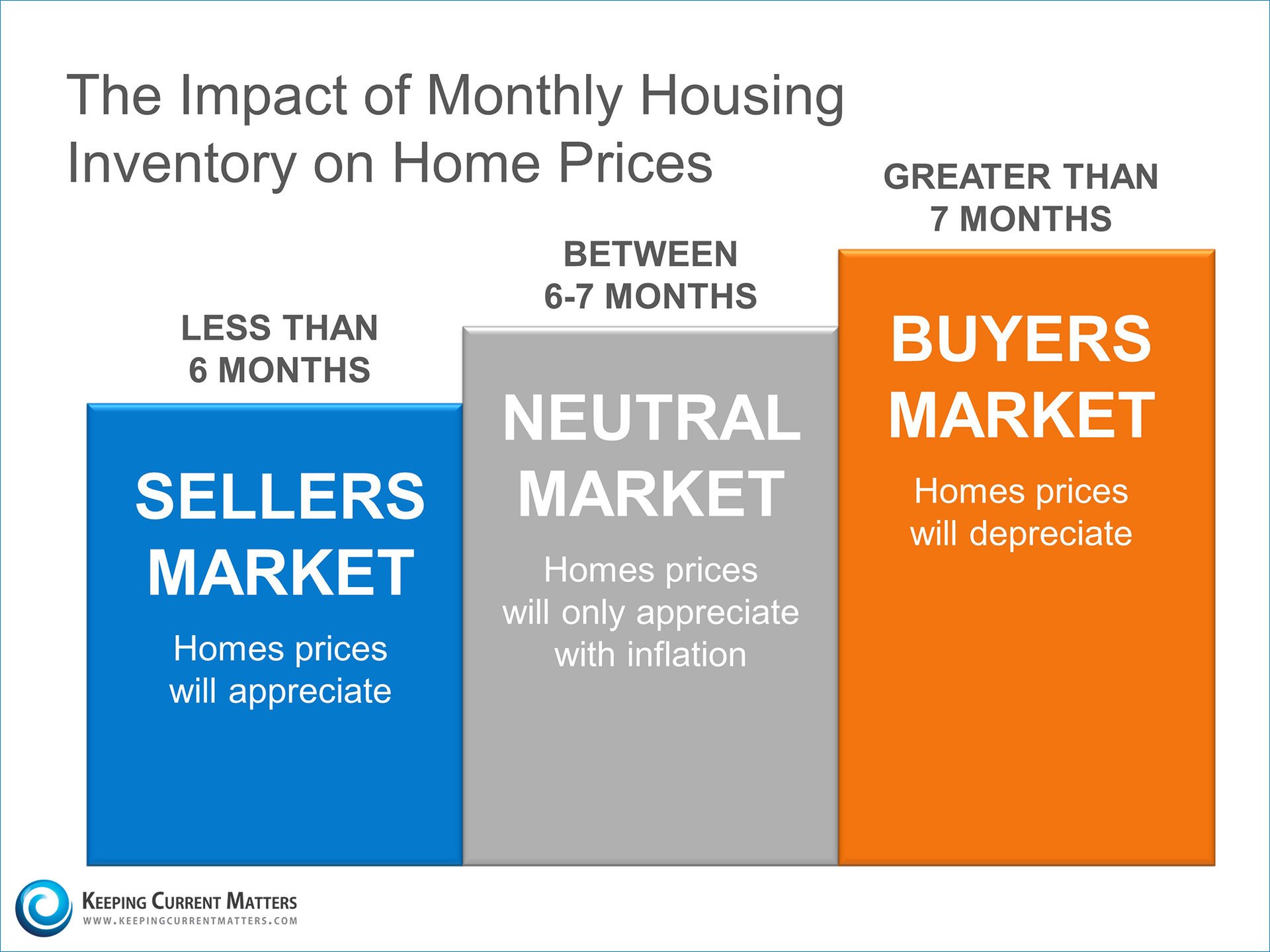
This is down 0.5% from last February and remains below the 6 months that is needed for a historically normal market.
Consumer confidence is at the highest level in over a decade. Pair that with interest rates still under 4%, new programs available for down payments as low as 3%, and you have an attractive market for buyers.
Buyer demand for housing remains twice as high as this time last year.

Prices Rising

February marked the 36th consecutive month of year-over-year price gains as the median price of existing homes sold rose to $202,600 (up 7.5% from 2014).

So What Does This Mean?

The chart below shows the impact that inventory levels have on home prices.
Impact of Inventory on Home Prices | Keeping Current Matters
NAR’s Chief Economist, Lawrence Yun gave some insight into the correlation:
"Insufficient supply appears to be hampering prospective buyers in several areas of the country and is hiking prices. Stronger price growth is a boon for homeowners looking to build additional equity, but it continues to be an obstacle for current buyers looking to close before (interest) rates rise."

Bottom Line

If you are debating putting your home on the market this year, now may be the time. The amount of buyers ready and willing to make a purchase is at the highest level in years. Contact us and we explain the process!

Thursday, March 26, 2015

Baby Boomers: Home Is Where The Heart Is

Within the next five years, Baby Boomers are projected to have the largest household growth of any Joint Center for Housing Studies of Harvard. Let’s take a look at why…
other generation during that same time period, according to the
In Merrill Lynch’s latest study, “Home in Retirement: More Freedom, New Choices” they surveyed nearly 6,000 adults ages 21 and older about housing.

Crossing the “Freedom Threshold”

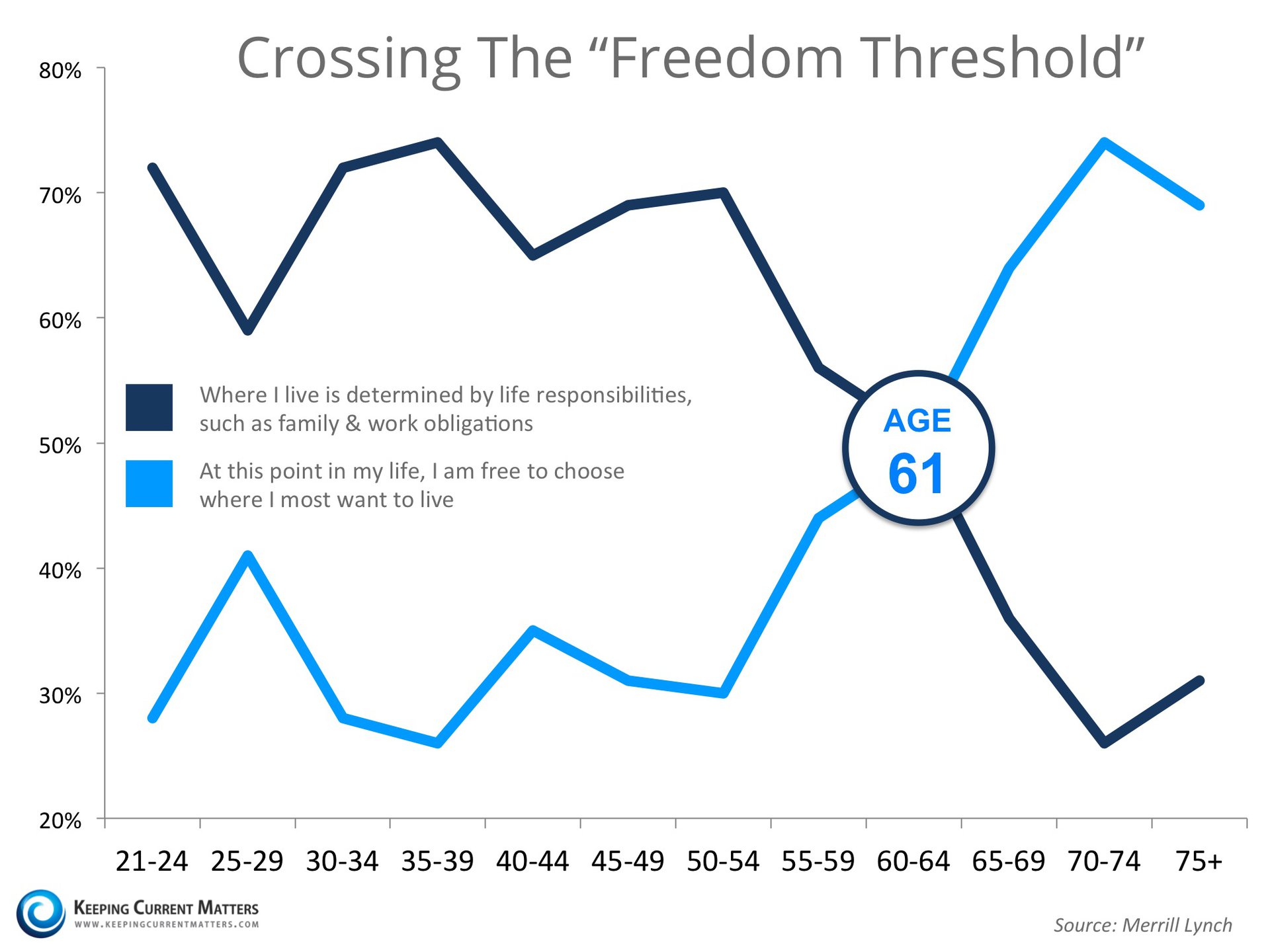
Throughout our lives, there are often responsibilities that dictate where we live. Whether being in the best school district for our children, being close to our jobs, or some other factor is preventing a move, the study found that there is a substantial shift that takes place at age 61.
The study refers to this change as “Crossing the Freedom Threshold”. When where you live is no longer determined by responsibilities, but rather a freedom to live wherever you like. (see the chart below)
Crossing The "Freedom Threshold" | Keeping Current Matters
As one participant in the study stated:
“In retirement, you have the chance to live anywhere you want. Or you can just stay where you are. There hasn’t been another time in life when we’ve had that kind of freedom.” 

On the Move

According to the study, “an estimated 4.2 million retirees moved into a new home last year alone.” Two-thirds of retirees say that they are likely to move at least once during retirement.
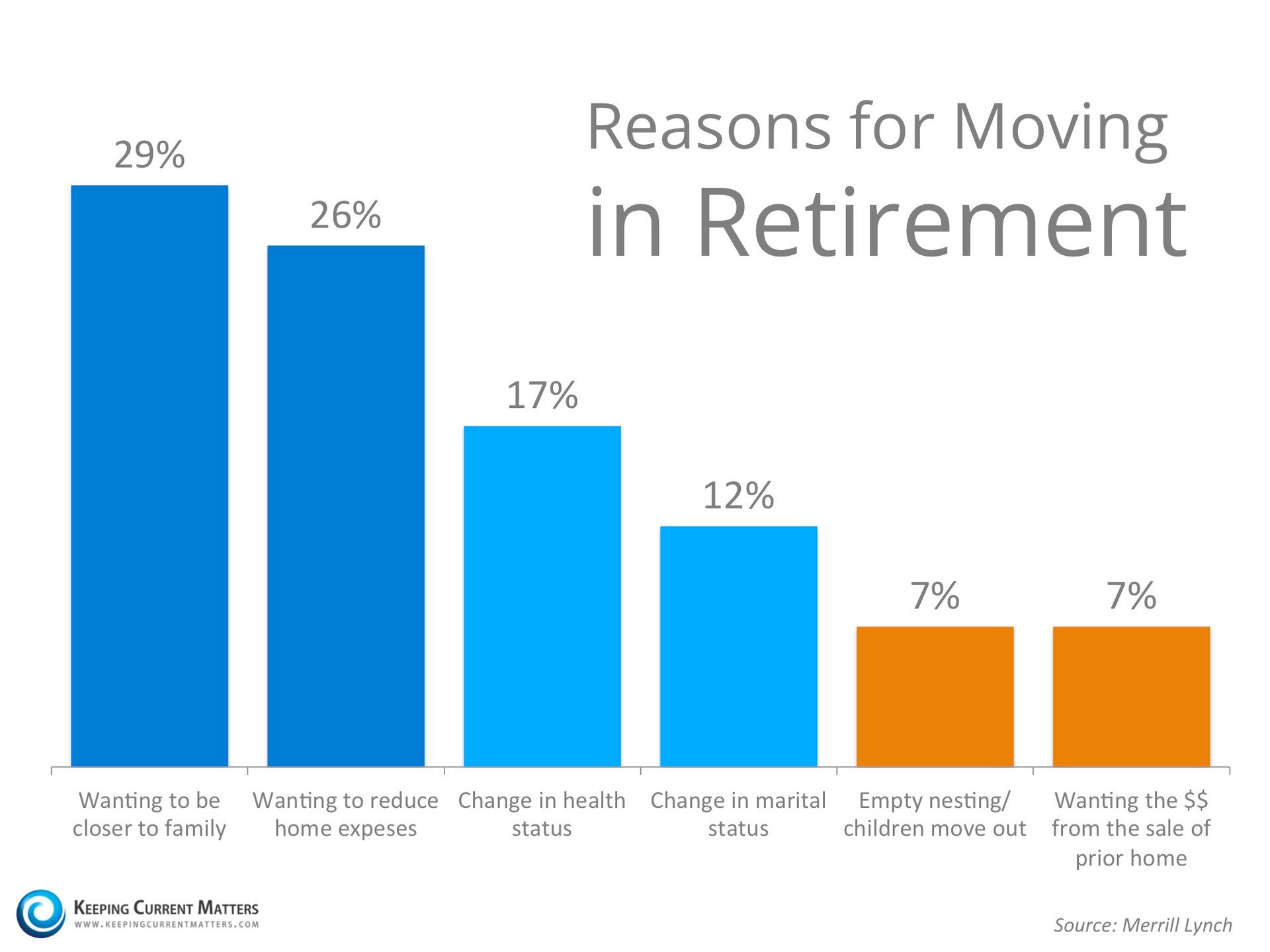
The top reason to relocate cited was “wanting to be closer to family” at 29%, a close second was “wanting to reduce home expenses”. See the chart below for the top 6 reasons broken down.
Reasons for Moving in Retirement | Keeping Current Matters

Not Every Baby Boomer Downsizes

There is a common misconception that as retirees find themselves with less children at home that they will instantly desire a smaller home to maintain. While that may be the case for half of those surveyed, the study found that three in ten decide to actually upsize to a larger home.
Some choose to buy a home in a desirable destination with extra space for large family vacations, reunions, extended visits, or to allow other family members to move in with them.
"Retirees often find their homes become places for family to come together and reconnect, particularly during holidays or summer vacations."

Bottom Line

If your housing needs have changed or are about to change, meet with a local real estate professional in your area who can help with deciding your next step.

Friday, February 20, 2015

Home Buying Tips for New Parents

Many expectant parents, or parents of a newborn,  upgrade to larger homes when baby’s on the way. If you’re thinking of buying a new home to accommodate your growing family, it’s important to assess certain factors you may not consider otherwise, including:

Master Bedroom Proximity – Is the master bedroom on a separate floor from the others? Will you want to be adjacent to your baby’s nursery, or are you comfortable with sleeping down the hall? Always consider the layout of the bedrooms before buying.

Pool Safety – If you’re seeking a home with a pool, keep in mind that your child will likely venture outside before he or she knows how to swim. Is the pool appropriately gated, with no holes or gaps in fencing? Are all latches and locks in proper working order? Is the door leading outside secure?

Property Hazards – Evaluate the home for any potential dangers, including stairs, tree roots or uneven pavers. These can be easily overlooked by a curious child and lead to unnecessary injury.

Street Location – Take into account how far your home is from a busy area. Is the home located on a congested street? What is the posted speed limit in the area and how fast do cars typically drive through the neighborhood? Are there streetlights and crosswalks nearby?


Friday, January 23, 2015

10 Things That Will Absolutely Kill Your Home Sale


When you're selling your home, you need every advantage you can get. And there are few homes that are magically market ready without a little help. If your home needs a touch more than a little help, it's time to get focused. After all, listing your home when it's not in the right condition to sell will probably only end in frustration. And, in this case, frustration means: your home sitting on the market for months with no offers or the errant, offensive, lowball.
If you want to make sure you get home sold quickly and for the right price, you'll want to avoid listing it with the following:
1. Excessive damage
Maybe the home you're selling was used as a rental and trashed by frat boy tenants, or maybe you just haven't kept it up as you should. Either way, those holes in the wall that look like the living room was used as a boxing gym, the scratched-up wood floors on which dinosaurs have clearly been racing, and the yard that's barren except for those two-foot-tall patches of weeds are not what buyers are looking for. Unless you're planning to offer your house for a price that will make buyers emphasize the good and ignore the bad and the ugly, it's going to need some attention.
2. Carpet in the bathroom
It's just gross. And everyone who walks into that bathroom is thinking one of two things: 1) There's gotta be mold under there; 2) There's gotta be pee on the floor around that toilet. This is one update you'll want to do before you list. Or, if you're already listed and your home's not selling.
3. Big, nasty stains
A buyer shouldn't know where your dog likes to mark or where your kids spilled the entire bowl of holiday punch. If the stains on your carpet are that bad, potential buyers will stroll in and run right back out. No one wants to buy a pigsty. Invest a few bucks in new carpet. You'll make the money back since you won't have to drop your sales price.
4. Pet smells
Speaking of pets…they smell. You probably don't notice since you live with them everyday, but buyers will, and it might be enough to turn them off. Deep clean the carpets and the upholstery, invest in some air fresheners, and remove cat boxes from the house for showings. The last thing you want is a potential buyer referring to your house as "the stinky one."
5. Loud dogs who bark every time someone approaches the home
One last word on pets. Barking happens, whether it's your dog or one that belongs to a neighbor. But you don't need that on the day of your open house. Offering to pay for doggie day care for a neighbor's pooch can eliminate the issue and help create the serene setting buyers want.
6. Your dead lawn
Lack of curb appeal won't necessarily kill a deal. In many cases, you won't even get potential buyers to get out of the car. If the front yard is a mess, buyers will naturally think the mess continues inside.
7. A bad agent
Face it. Not all of them are winners. If your agent is: rude, uninformed, lazy, uncommunicative, belligerent, or unwilling to take your opinions into consideration, get a new one. An agent who isn't giving their client the right type of attention probably isn't going to get the job done.
8. Your sloppiness
Those drawers and cabinets you shoved everything into when you cleaned off your kitchen and bathroom cabinets could be a deal breaker for picky buyers. We all know buyers open stuff. They look in drawers, they open cabinets, they examine closets. If these spaces are messy and overstuffed, they may assume there's not enough storage space.
9. Unreasonable sellers
Big problems in your house can be deal killers, but they can also be deal sealers, if you are reasonable. If your inspection uncovers plumbing, electrical, or roofing problems (or all three!) and you're unwilling to negotiate, you can kiss that sale goodbye.
10. Bad Taste
Your poor decorating choices and failure to keep up with trends from this year—or century—may haunt you when it's time to sell. If it's true that many buyers have no vision—and all you have to do is watch House Hunters and observe a buyer getting hung up on a paint color to know that's true—then you are really in for it with your crowded house full of ugly, outdated crap. A few simple updates can help it to look fresh and give buyers something to fall in love with. Not sure where to start? Check out FrontDoor's 15 Updates That Pay Off and HGTV's 10 Best-Kept Secrets For Selling Your Home.
Courtesy of Realty Times

Friday, December 26, 2014

5 Real Estate New Year's Resolutions You Should Make

At the end of every December, people make all kinds of resolutions for the coming year. Typically, these are things they want to improve about themselves, ways to make their day-to-day personal or work life better, or ideas to put them on track for a change. Many times these surface as a result of mistakes made in the past 12 months.

When it comes to real estate, resolutions don't necessarily apply as it's unlikely that you do a real estate transaction each year. Furthermore, you can't actually resolve to buy your neighbor's house or sell your $350,000 home for $1 million. Well, you could, but you'd probably be setting yourself up for disappointment right from the start.

Some things are simply out of a would-be buyer or seller's control. But, as a would-be buyer or seller, you can learn from and make resolutions based on those who have gone before you. There exists a former buyer who, if he could, would resolve to have done more legwork before buying. Conversely, there's a current seller who resolves to take the next under-asking-price offer from a buyer more seriously.

Whether you plan to buy or sell, there are some real estate resolutions that buyers and sellers can -- and should -- make. Here are five to get you started.

Buyers: Resolve to Get Your Financial House in Order

Planning a home purchase takes time and effort, so you should consider meeting with a mortgage professional early in the year. Know your credit score and understand what your financial situation looks like from a lender's perspective. If you have credit issues, identify what they are and the necessary steps to correct them. Sometimes, it can take six months to see your FICO score move up the much-needed 20 points to get you a better mortgage rate. A good real estate agent can recommend an experienced, local mortgage professional. Local is always important, because many real estate deals are made on relationships, and being able to meet face-to-face with your mortgage professional can be a big plus.

Sellers: Resolve to Think of Your Home as a Product

Start clearing out old stuff now. If there are things deep in your closets that you don't think you'll use between January and the time you move, consider a storage locker or making space in the garage. Does your real estate agent suggest that the basement needs a paint job? Get some painting bids now. Have you always hated how the bathroom vanity takes up so much space? Consider changing it now so buyers will perceive your bathroom as bigger. This will also help you spread out the costs of home repairs and changes over several months.

Buyers: Resolve to Start Feeling Out the Market Early

You may think you only need to go to open houses once you're ready to buy. But in reality, a buyer needs a couple of months learning the marketing, understanding home values, the prices per neighborhood and the market in general. Going to open houses in the neighborhoods where you want to buy will allow you to start feeling out the market. It may also be the best way to meet your future real estate agent. Many agent/buyer relationships are forged at open houses.

Once you engage an agent, you may make several offers before you get into your dream home. Having your agent along for the ride will allow you to compare and contrast homes you've visited to the home you eventually buy. The homes you see and your experience feeling out the market will serve as the building blocks toward becoming an informed buyer and making your best offer.

Sellers: Resolve to Understand Your Timing and Exit Strategy

One of the biggest stresses on a seller is trying to plan a purchase and a sale at the same time. Can you afford to close on the new home before selling? If so, for how long? Do you need to sell the property first? If so, will the potential sale price support a home purchase in the neighborhood you want to be in? If not, what other areas should you be looking in? Selling and buying at the same time brings up all kinds of financial, emotional and physical stress.

Uprooting yourself from your home is not easy. What if you have to go into short-term housing? How will you get that set up and how long would you need to commit for? If you can afford to purchase and then sell, do they need to happen quickly? Are there things you can be doing in your current home so that once your new home closes, you'll be ready to list? It's a lot to think about and plan for, and it helps to have a strategy in place well before you have to take action.

Buyers and Sellers: Resolve to Engage a Real Estate Agent Now

Planning a home purchase or sale takes time. Engaging a real estate agent early in the process will allow you to have an expert on hand as you start to put the pieces together. A good real estate agent doesn't just show and sell homes: They can be your strategic adviser, even well in advance of any actual transaction.

On the seller side, if you pulled a permit to install some new windows or replace some dry rot in 2005, likely the contractor issued a permit. But did he close it out? A good agent will figure that out and clean it up before it becomes a transaction issue. You should use your agent to literally get your house and listing in order.

For buyers, having an agent with you from the start is like having an experienced second set of eyes and ears. Having so many transactions under the belt and years of market knowledge in their head, a real estate agent's opinions, thoughts and ideas can save you a lot of time and money. What's more, they can keep you on the right path toward identifying the best home, and they'll see you through the process all the way to the closing.

Article courtesy of Zillow.com

Monday, December 22, 2014

Will Recovery Be Steadier in 2015?

The housing market this year has been on a roller coaster. According to the National Association of REALTORS®, existing-home sales are expected to fall short of 2013's total, and price gains have slowed significantly. However, builder confidence in the new-home market has been on the rise, even as new-home sales have barely budged — at just a 1.8 percent increase in October compared to a year earlier.


Economists say the housing market is showing mixed signals because it's normalizing, leveling off after a much more rapid recovery last year that was unsustainable.
Forbes.com recently highlighted several 2015 predictions from housing experts:
  1. Home appreciation will continue to slow. Prices didn't increase as fast this year, and they are expected to stick to that trend into the new year. "Easing housing inventory levels and the exit of investors from the market are helping to put the brakes on home-price escalation," Forbes.com reports. "At a deeper level, this change represents a fundamental shift in the market: We've moved out of rapid recovery phase and into a new normal." Gone are the double-digit gains of 2013. Realtor.com® predicts an annual gain in home prices of 4 percent to 5 percent next year. 
  2. Buying frenzy becomes more muted. The home-buying process is expected to be less chaotic in the new year, with for-sale inventories easing and credit loosening, which could make it easier for first-time home buyers to enter the market. Investors have also pulled back in many markets. NAR statistics from October show that individual investors purchased 15 percent of homes, a drop from 19 percent year-over-year. Also, as more homes come on the market, buyers will have more choices and sellers may face more of the competitive pressure. Housing analysts note that this can help create a more balanced market for everyone: buyers in search of a competitive advantage and sellers who turn around and become buyers themselves.
  3. Mortgage interest rates will finally be on the rise. The Mortgage Bankers Association still predicts that mortgage rates will increase to 5 percent by the end of 2015. Freddie Mac expects a 4.5 percent average in 2015. However, in 2013, economists had predicted mortgage rates to reach 5 percent by the end of this year. The 30-year fixed-rate mortgage has averaged below 4 percent in recent weeks. But with the end of the Federal Reserve's quantitative easing, MBA believes that a short-term fund rate hike is more likely by mid-2015, which would then push interest rates up.
  4. Rent rises will outpace home value growth. Rents likely will continue to keep rising in the new year, and many housing analysts predict that an increase in rental costs in 2015 will outpace annual home-price gains. The rental market will likely remain a "landlord's market" in 2015, with vacancy rates expected to stay below 5 percent in the new year, according to NAR forecasts. That should lead to demand pushing rents up even higher and keeping them above inflation, NAR Chief Economist Lawrence Yun notes. Apartment rents are projected to increase 4 percent in 2014 and 4.1 percent in 2015. The rise in rents could push more Millennial renters to become home owners. Realtor.com® analysts predict that households headed by Millennials will drive household formations in the new year. Millennials are expected to drive two-thirds of household formations over the next five years, according to realtor.com®'s predictions. "Next year's addition of 2.75 million jobs and increased household formation will be the two key factors driving first-time buyer sales," realtor.com® notes. 
  5. Builders shift to building less expensive homes. In the last few years, builders have been building fewer, more expensive homes. But that trend may change in the new year, as more builders look to target less-expensive markets. New-home sales are expected to top the 500,000 mark in 2015, but in order to do that, builders may have to sell less expensive homes, housing analysts note. Earlier this year, representatives from D.R. Horton, the nation's largest home builder, said they planned to capture more of the entry-level market with its newly launched brand called Express Homes. The properties will be priced between $120,000 and $150,000, and they will be concentrated in Texas, Georgia, and Florida. "We wouldn't be getting into Express Homes if we didn't think it was the next segment of the market to recover," D.R. Horton CEO Donald Tomnitz told CNBC in April.
  6. Foreclosures fall back to pre-recession levels. Foreclosure filings have been on the decline this year and are expected to continue their descent well into 2015. From January through November, foreclosure filings fell about 172 percent compared to the same period one year prior, according to RealtyTrac. "Every month so far this year, we've been down from a year ago," says Daren Blomquist, vice president of RealtyTrac. The only uptick has been in foreclosure auctions, which are up 5 percent in November compared to one year earlier. Foreclosures will likely fall to pre-crisis levels in 2015, Blomquist predicts.
Information courtesy of the California Association of Realtors (C.A.R) - Daily Real Estate News | Monday, December 22, 2014

Friday, November 14, 2014

Current Trends and Statistics for San Luis Obispo County

We are consistently asked "how's the market doing?" We love this question and we love giving factual information from our local Multiple Listing Service (MLS) for San Luis Obispo County. The most recent Trends and Statistics through October 2014 just came out. Here are a few graphs that show exactly how the market is doing:

Months of Inventory - The number of months of inventory is down.


Price Per Square Foot - The price per sq. ft. on closed sales is up.


Supply and Demand - Supply is down, demand is up.


Days on Market - The average days of homes on the market is up.

 
So, what does all this mean? When the inventory of homes is between 3 and 6 months we call this a neutral market. If the listings continue to increase and the sales stay at the same level, then the buyers will start to have an advantage because there are too many homes for sale. Conversely, if listings start to decease, which they did last year, and sales hold steady, the advantage will turn towards the seller. If we see either of these changes, we'll keep you posted.

Please contact us for more insight and feel free to pass this information on to anyone that has been thinking of buying or selling a home. We look forward to the opportunity of helping you! 

Friday, October 31, 2014

Top 5 Things to Know When Preparing to Sell or Buy in 2014


It's hard to believe that November is here and there are only 2 more months left in the year. The questions we've been hearing over and over is ... should we buy or sell this year?
For the first time in years, rising home prices are boosting sellers' confidence. At the same time, interest rates remain amazingly low, helping to boost potential homebuyer's confidence. Millions of Americans will decide in 2014 to put their homes on the market and/or shop for new homes, and need to understand the current houing market conditions as they move closer to buyer or selling homes.
The following "Top 5 things to know when preparing to sell or buy a home in 2014" should be considered by anyone thinking about a home sale or purchase:


Mortgage Rates as of 10/31/14 
                                                                            
Conv.- 3.875% (Up to 417k) 
FHA  - 3.5 %  
VA    -  3.5 %  
Jumbo - 3.75 %  
(from 417k and up to jumbo loan amounts)
 
                                                                                             Rates courtesy of Bankrate.com
WOW!! Rates are under 4% again. VERY exciting! It's time to take advantage of this year end opportunity. Let us know if you, or someone you know,
is in the market to buy or sell a home. We'd love to help!

Friday, October 17, 2014

Ten Things to Know About 1031 Exchanges

Tax nerds may be able to spout off Internal Revenue Code Sections, but most people never get
beyond 401(k). (That’s right, your workplace retirement savings plan is named after a section of the tax code!)
Still, “Section 1031″ is slowly making its way into daily conversation, bandied about by realtors, title companies, investors and soccer moms. Some people even insist on making it into a verb, a la FedEx , as in: “Let’s 1031 that building for another.” (While Section 1031 isn’t restricted to real estate, that’s clearly where most of the discussion takes place.)

So what is 1031? Broadly stated, a 1031 exchange (also called a like-kind exchange or a Starker) is a swap of one business or investment asset for another. Although most swaps are taxable as sales, if you come within 1031, you’ll either have no tax or limited tax due at the time of the exchange.
In effect, you can change the form of your investment without (as the IRS sees it) cashing out or recognizing a capital gain. That allows your investment to continue to grow tax deferred. There’s no limit on how many times or how frequently you can do a 1031. You can roll over the gain from one piece of investment real estate to another to another and another. Although you may have a profit on each swap, you avoid tax until you actually sell for cash many years later. Then you’ll hopefully pay only one tax, and that at a long-term capital gain rate (currently 15%).
Warning: Special rules apply when depreciable property is exchanged in a 1031. It can trigger gain known as “depreciation recapture” that is taxed as ordinary income. In general, if you swap one building for another building, or one machine for another machine, you can avoid this recapture. But if you exchange improved land with a building for unimproved land without a building, the depreciation you’ve previously claimed on the building will be recaptured as ordinary income.
Such complications are why you need professional help when you’re doing a 1031. Still, if you’re considering a 1031–or just curious–here are 10 things you should know.

1. A 1031 isn’t for personal use.
The provision is only for investment and business property, so you can’t swap your primary residence for another home. There are ways you can use a 1031 for swapping vacation homes, but this loophole is much narrower than it used to be. For more details, see No. 10.
2. But some personal property qualifies.
Most 1031 exchanges are of real estate. However, some exchanges of personal property (say a painting) can qualify. Note, however, that exchanges of corporate stock or partnership interests don’t qualify. On the other hand, interests as a tenant in common (sometimes called TICs) in real estate do.
3. “Like-kind” is broad.
Most exchanges must merely be of “like-kind”–an enigmatic phrase that doesn’t mean what you think it means. You can exchange an apartment building for raw land, or a ranch for a strip mall. The rules are surprisingly liberal. You can even exchange one business for another. But again, there are traps for the unwary.
4. You can do a “delayed” exchange.
Classically, an exchange involves a simple swap of one property for another between two people. But the odds of finding someone with the exact property you want who wants the exact property you have are slim. For that reason the vast majority of exchanges are delayed, three party, or “Starker” exchanges (named for the first tax case that allowed them). In a delayed exchange, you need a middleman who holds the cash after you “sell” your property and uses it to “buy” the replacement property for you. This three party exchange is treated as a swap.
5. You must designate replacement property.
There are two key timing rules you must observe in a delayed exchange. The first relates to the designation of replacement property. Once the sale of your property occurs, the intermediary will receive the cash. You can’t receive the cash or it will spoil the 1031 treatment. Also, within 45 days of the sale of your property you must designate replacement property in writing to the intermediary, specifying the property you want to acquire.
6. You can designate multiple replacement properties.
There’s long been debate about how many properties you can designate and what conditions you can impose. The IRS says you can designate three properties as the designated replacement property so long as you eventually close on one of them. Alternatively, you can designate more properties if you come within certain valuation tests. For example, you can designate an unlimited number of potential replacement properties as long as the fair market value of the replacement properties does not exceed 200% of the aggregate fair market value of all the exchanged properties.
7. You must close within six months.
The second timing rule in a delayed exchange relates to closing. You must close on the new property within 180 days of the sale of the old. Note that the two time periods run concurrently. That means you start counting when the sale of your property closes. If you designate replacement property exactly 45 days later, you’ll have 135 days left to close on the replacement property.
8. If you receive cash, it’s taxed.
You may have cash left over after the intermediary acquires the replacement property. If so, the intermediary will pay it to you at the end of the 180 days. That cash–known as “boot”–will be taxed as partial sales proceeds from the sale of your property, generally as a capital gain.
9.You must consider mortgages and other debt.
One of the main ways people get into trouble with these transactions is failing to consider loans. You must consider mortgage loans or other debt on the property you relinquish, and any debt on the replacement property. If you don’t receive cash back but your liability goes down, that too will be treated as income to you just like cash. Suppose you had a mortgage of $1 million on the old property, but your mortgage on the new property you receive in exchange is only $900,000. You have $100,000 of gain that is also classified as “boot,” and it will be taxed.
10. Using 1031 for a vacation house is tricky.
You can sell your primary residence and, combined with your spouse, shield $500,000 in capital gain, so long as you’ve lived there for two years out of the past five. But this break isn’t available for your second or vacation home. You might have heard tales of taxpayers who used a 1031 to swap one vacation home for another, perhaps even for a house where they want to retire. The 1031 delayed any recognition of gain. Later they moved into the new property, made it their primary residence and eventually planned to use the $500,000 capital gain exclusion.

In 2004 Congress tightened that loophole. Yes, taxpayers can still turn vacation homes into rental properties and do 1031 exchanges. Example: You stop using your beach house, rent it out for six months or a year and then exchange it for other real estate. If you actually get a tenant and conduct yourself in a businesslike way, you’ve probably converted the house to investment property, which should make your 1031 exchange OK. But if you merely hold it out for rent but never actually have tenants, it’s probably not. The facts will be key, as will the timing. The more time that elapses after you convert the property’s use the better. Although there is no absolute standard, anything less than six months of bona fide rental use is probably not enough. A year would be better.

If you want to use the property you swapped for as your new second or even primary home, you can’t move in right away. In 2008 the IRS set forth a safe harbor rule under which it said it would not challenge whether a replacement dwelling qualified as investment property for purposes of a 1031. To meet that safe harbor, in each of the two 12-month periods immediately after the exchange: (1) you must rent the dwelling unit to another person for a fair rental for 14 days or more; and (2) your own personal use of the dwelling unit cannot exceed the greater of 14 days or 10% of the number of days during the 12-month period that the dwelling unit is rented at a fair rental.

Moreover, after successfully swapping one vacation/investment property for another, you can’t immediately convert it to your primary home and take advantage of the $500,000 exclusion. Before the law was changed in 2004 an investor might transfer one rental property in a 1031 exchange for another rental property, rent out the new rental property for a period of time, move into the property for a few years and then sell it, taking advantage of exclusion of gain from the sale of a principal residence. Now, if you acquire property in the 1031 exchange and later attempt to sell that property as your principal residence, the exclusion will not apply during the five-year period beginning with the date the property was acquired in the 1031 like-kind exchange. In other words, you’ll have to wait a lot longer to use the primary residence capital gains tax break.

Thursday, August 21, 2014

Do's and Don'ts of Lending Today

Getting a home loan these days is a very interactive process. We have been told by lenders that they are amazed by how many clients they work with are unaware of all the pitfalls they face during the loan process. To help avoid any surprises while waiting for final approval, we'd like to provide you with a short list of "do's and don'ts" to follow.

Let's start with the "do's" ...
1. Do keep the process moving by responding to your loan officer's requests for documentation as soon as possible.
2. Do make decisions as soon as is reasonably possible.
3. Do convey questions or concerns you have as they develop.
4. Do continue to make all of your rent or mortgage payments on time.
5. Do stay current on all other existing mortgages.
6. Do continue to work your normal work schedule.
7. Do continue to use your credit as normal.
8. Do be prepared to explain any large deposits in your bank accounts.
9. Do enjoy purchasing your home but remain objective throughout the process to help make decisions that are best for you.

After you have been pre-approved for your mortgage you will want to refrain from the following ...
1. Do not make any major purchases (car, boat, jewelry, furniture, etc.)
2. Do not apply for any new credit (even if it says you are pre-approved or "xxx days same as cash").
3. Do not pay off charges or collections (unless directed by your loan officer to do so).
4. Do not make any changes to your credit profile.
5. Do not change bank accounts.
6. Do not make unusual deposits into your bank accounts or move money around from one account to another.

Follow these simple rules and you will help to make your loan closing as smooth and hassle-free as possible!!

Wednesday, June 25, 2014

How to Choose Your Listing Agent


Hiring a listing agent is crucial to your entire experience as a home seller. The person you choose will be involved in preparing your home for sale, establishing a listing price, marketing your property and negotiating the transaction.
While you might be tempted to hire a friend who has a real estate license or your co-worker’s sister, remember that the person you enjoy meeting for drinks isn’t always the best REALTOR® to represent your interests. That friend could turn out to be the right agent for you, but before you choose him or her, take the time to get recommendations for several agents and interview them.
You’ll be paying a significant commission to this person (often 6% of the sales price of your home), spending time with them, and relying on their advice to sell your home for the best possible price and as quickly as possible given market conditions.
What to Look for in an Agent
Many sellers are tempted to choose the REALTOR® who suggests the highest list price for their property and who gives their home the most compliments, but you’re better served by a realistic REALTOR®.
You need to find a REALTOR® with whom you can communicate easily, someone who knows your neighborhood well and has a good marketing plan to reach buyers who are not only interested in your home but are also qualified to buy it. Most REALTORS® have experience looking at homes and can offer advice about the condition of your home and ways to improve its appeal without overspending.
When you talk to neighbors and friends about their recommendations for a REALTOR®, ask them how easy it was to reach the agent when they had questions, and how much support and advice the agent gave them throughout the sales process.
Questions to Ask During the Interview
A REALTOR® typically has a listing presentation she provides for sellers—often in the sellers’ home so that she can get a look at the property and its condition. Some of your questions may be answered during the presentation, but if not, you may want to ask the following:
  • Are you a member of the National Association of Realtors? REALTORS® must abide by the NAR’s code of ethics. In addition, each state’s real estate license requires continuing education for agents.
  • How many sales did you complete last year?
  • In what price range do you sell most of your homes?
  • What was the average difference between sales price and list price? While this depends on your local market conditions, a REALTOR® who often sells homes well below list price may not be advising sellers to price their homes correctly or may be inadequately marketing homes.
  • What is your marketing plan for my home? How many websites will include information about my home? Where will you look for buyers?
  • Do you have advice for me about the condition of my home? Do you have expertise as a home stager or do you recommend that I hire a professional stager?
  • Can you recommend contractors and moving companies?
  • How often should I expect to hear from you when my home is on the market?
  • Will you provide me with regular feedback and updates about potential buyers?
Pricing Advice
The most important conversation you will have with your agent is about the price of your home. The REALTOR® you choose should present you with a comprehensive market analysis that compares similar homes that are on the market, have sold recently and have been taken off the market.
You are paying for your REALTOR®’s knowledge and expertise, so listen carefully to the advice you receive and choose your agent thoughtfully.

Courtesy of Realtor.com

Tuesday, May 13, 2014

How may times have you heard these phrases:
"I'm tired of throwing money away on all the expenses associated
with being a homeowner." 
--- or ---
"If you're renting, you're throwing money away."  

Our society holds a pervasive myth that rent is "throwaway" money. But the truth, however, could also be linked to being a homeowner. In both cases, you're exchanging money for a desired good or service. The question, then, becomes: Which do you desire more? Would you be happier buying or renting? And, which one makes more sense at any given point in time?

Let's take a look at some of the factors that should play into your decision:

Advantages of Renting: 
#1 - Mobility. As a renter you have the flexibility and freedom to move to any new locate whenever you would like.
#2 - Price flexibility. As a renter you have the flexibility to change the price that you pay for housing depending on where you want to live.
#3 - Lower costs. In many areas, the cost of renting is actually cheaper than the cost of owning a home. 

Advantages of Owning:
#1 - Potential Appreciation. Many homeowners point to the rising value of their home to defend their decision to purchase a property.
#2 - Inflation Protection. If you're a homeowner with a fixed-rate mortgage, you can rest assured knowing that your monthly payments will never change, regardless of what happens with interest rates and inflation in the future. 
#3 - Emotional Satisfaction. Here's one of the biggest benefits to homeownership: You'll enjoy a home that's purely yours. 

Here is a diagram that can better help you decide 
if you can afford to buy vs. rent:
 

So, make the choice that best fits your priorities and personality. 
If you are considering a home purchase (or know of someone who is) now is a great time! 
Give us a call to see how we can help you.
We're here to Help You Make the Right Move!

Friday, September 6, 2013

The New FREE Keller Williams and Fissori Real Estate Team Mobile App

Are you on the search for your next home or investment property? Are you curious about what’s for sale in your neighborhood? Do you want to find open houses nearby? With the Keller Williams Realty Real Estate Search mobile app, finding the right home is as easy as drawing a circle on a map! Designed for today’s tech savvy homebuyers, this easy-to-use GPS-powered app puts you in control of your real estate search.
For more daily real estate advice, whether you are selling, buying, or just thinking about it, follow the Fissori Real Estate Team on Facebook and Twitter!
Key features of the KW mobile app include:
  • Dynamic Map: Add a pinpoint or draw a perimeter to see nearby homes for sale, open houses, or rental properties
  • Custom Searches: Add search filters like price, neighborhood, number of beds, open houses, and more
  • Full-Screen Photo Gallery: Scroll through vivid, full-screen photos of homes
    Stay In The Know: Get notified of new real estate listings that meet your exact search criteria
  • Get Local: See what schools and other points of interest nearby.
  • Anytime Access: Save searches and listings, including notes or added property photos, across all your devices
  • Share information: Easily share homes through text, email, Facebook or Twitter
  • Be Calculated: Free mortgage calculator to estimate home loan and monthly payments
Optimized for your phone or tablet, the Keller Williams Realty Real Estate Search app brings you the best experience in the search for your next home. To connect with the KW Fissori Real Estate Team mobile app, The App is available at the App Store on your iPhone, the iTunes Store for your iPad, and available on Google Play for the Android. Once you download the App, enter our agent code at the startup of the app or via the "My Agent" button on the main menu. Just enter the code KW1P8TWRC when you install the free application. Happy Searching!

Saturday, August 31, 2013

Home Flipping Makes Comeback

“Home flipping,” a term used to describe buying a home at a discount, refurbishing it and then selling it a profit, is making a comeback thanks to the recovery in the U.S. housing market. Experts say the time is ideal for flipping because properties are still available for a bargain in many areas, but are rising quickly in value. Reality TV made the practice look easy for a time, but many found out it was harder than it looked after the financial crisis led to a housing market tumble. Now, analysts say the best places to flip homes are those areas that suffered the most during the crash, like Arizona, Florida and Nevada. 

The rebounding U.S. real-estate market is leading to a renaissance in "home flipping" -- the investment strategy in which you buy distressed houses, make minor upgrades and resell the properties a few months later for quick gains.
"Right now is an ideal [time] for flipping, because we're seeing home prices bounce off of the bottom," says Daren Blomquist of RealtyTrac.com, which recently named the 25 Top U.S. Markets for Flipping Homes -- including some that offer more than 50% gross returns.
Made popular by reality-TV shows such as Flip This House>, home flipping looked easy during the housing boom when prices kept rising. The strategy became decidedly harder during the real estate bust that followed.
Now, flipping is enjoying a comeback because home prices have bottomed out in many U.S. locales and begun to rebound.
Blomquist says today's best markets for flippers soared during the boom and collapsed during the bust. Many are also in the so-called "Sand States" of Arizona, Florida and Nevada, which suffered through some of the nation's highest foreclosure rates in recent years.
"These markets all crashed pretty hard, so they've got lots of available distressed properties," Blomquist says. "But they're also perpetually popular with consumers because they're located in the warmer climates that many people want to move to."
Here's a look at the five metro areas RealtyTrac believes offer today's best opportunities for home flips (defined as buying and selling the same property within six months).
The site ranked each city based on how much gross profit local home flippers enjoyed in percentage terms on the average 2012 single-family sale, excluding renovations and other expenses beyond what investors initially paid for properties. All cities also had at least 500 home flips during 2012, as well as 9% or higher average annual home-price appreciation during 2013's first quarter. 
Fifth-best U.S. city for home flippers: Memphis, Tenn.
Average gross profit on 2012 deals:
 42%
Memphis is unusual among the markets at the top of RealtyTrac's list that it's not in a Sand State, nor did it have the massive housing boom and bust other cities saw in recent years.
Still, Blomquist says the 1.3-million-person metro area is hot among flippers because it's got lots of older houses that cost little to buy and lend themselves to quick fix-ups and resales.
RealtyTrac found that the average Memphis home flipper paid just $68,318 per house last year (the lowest price among the top five cities in the rundown), but resold properties for $96,870. That's a 42% gross gain.
Another plus: The average Memphis home price rose at a 13% annual rate in 2013's first quarter. 
Fourth-best U.S. city for home flippers: Tampa, Fla.
Average gross profit on 2012 deals:
 43%
The U.S. housing bust and foreclosure crisis slammed Tampa, but Blomquist says that means the 2.9-million metro area has lots of distressed properties for flippers to choose from.
The Cigar City also has an aging housing stock that's ripe for renovation, plus a warm climate that's popular with consumers -- all of which add up to great potential for home flips.
RealtyTrac found that the average Tampa property flipper enjoyed a 43% gross return in 2012, paying $79,538 for a house but selling for $113,676. Average Tampa home prices also rose at a 9% annual rate during the three months ended March 31. 
Third-best U.S. city for home flippers: Phoenix, Ariz.
Average gross profit on 2012 deals:
 44%
Like the phoenix of Greek mythology, the Phoenix housing market is rising from its own ashes.
One of the U.S. cities hardest hit by the housing bust, Arizona's capital has recently seen real estate rebound sharply. Average Phoenix-area home prices soared 33% between 2012's first quarter and 2013's opening three months -- the strongest appreciation of any city atop RealtyTrac's rankings.
All told, the typical 2012 Phoenix home flip generated a 44% gross return, with investors paying $146,528 on average per property but selling for $210,290.
Still, Blomquist warns that Phoenix home values are rising so fast that he sees "the biggest red flags among any of the top five cities on our list. The market there might be overheating and a new bubble forming." 
Second-best U.S. city for home flippers: Las Vegas
Average gross profit on 2012 deals:
 53%
Las Vegas had America's highest foreclosure rate for 60 straight months between mid-2007 and mid-2012, but Sin City's housing market is rebounding faster than you can say "hit me."
Average home prices in the 2 million-population metro area rose at a 24% annual clip during the first quarter, while the typical local flipper paid $133,198 per home in 2012 but sold for $203,945. That works out to a 53% gross return.
"Las Vegas had a very dramatic boom-and-bust cycle over the past seven years, but prices probably overcorrected," Blomquist says. "Investors finally realized that prices got too low, so it's made sense to them to jump back in." 
Best city for home flippers: Orlando, Fla.
Average gross profit on 2012 deals:
 63%
Walt Disney World's (DIS) hometown has become a real Magic Kingdom for home flippers.
Blomquist says that while Orlando had one of America's worst foreclosure rates over the past five years, average local home prices rebounded at a 12% annual rate during 2013's first three months.
RealtyTrac also found that flippers paid a modest $103,701 on average per property in 2012 but sold for $168,677 -- a 63% gross return.
Blomquist says Orlando homes have historically enjoyed strong resale demand from retirees and warm-weather lovers. He adds that if you can't successfully flip a home, you can usually turn it into a vacation rental -- "a good, solid fallback plan."
This article was republished with permission from TheStreet.

Saturday, August 24, 2013

Home Value Highest Since '07 as U.S. Houses Make Cash

More American homeowners will be able to use their properties as cash machines again after real estate equity jumped last year by the most in 65 years. Property owners recaptured $1.6 trillion as home values climbed to the highest levels since 2007. The amount by which the value of the houses exceeds their underlying mortgages rose to $8.2 trillion last year, a gain of 25 percent, according to Federal Reserve data.
An expanding group of homeowners is able to get cash from their properties as banks show more willingness to make home equity loans with the market’s recovery. Originations for the mortgages should rise 10 percent to almost $83 billion this year, from about $75 billion in 2012, said Shaun Richardson, a vice president at Icon Advisory Group, a mortgage analytics firm in Greensboro, North Carolina. About 6 percent of lenders eased equity-mortgage standards at the end of 2012, the most in 18 months, according to the Fed.
“Lenders are starting to come back into the marketplace,” saidGreg McBride, a senior financial analyst at Bankrate Inc. “We’re not going back to the wild, Wild West we saw during the real estate boom, but we are going to see more people spending their equity.”
Americans went on a spending spree in the five years before the 2006 peak of the real estate market, tapping about $800 billion of their rising equity to spend on everything from cars and televisions to debt consolidation and college tuition.
Declared Worthless
At the beginning of the financial crisis in 2008, close to $1 trillion of the loans were outstanding at U.S. banks and credit unions, an all-time high, according to the Fed. In the housing crash that followed, banks wrote off, or declared worthless, about $251 billion of home equity loans, according to the Federal Deposit Insurance Corp.
The year-old real estate recovery is helping to ease defaults. The volume of equity loans 90 days or more overdue dropped 25 percent in the fourth quarter to $3.2 billion from the prior period, according to the FDIC. As a result, banks are beginning to view equity lending as a potential source of income, rather than losses, said Stuart Feldstein, president of SMR Research Corp., a consumer-lending research firm in Hackettstown, New Jersey.
“This could be the year banks see the home-equity business return to black ink, as long as defaults continue to decline,” Feldstein said.

Credit Quality

Home-equity mortgages held by banks probably will yield a 0.2 percent return on assets this year, which is the after-tax income on outstanding loans, Feldstein said. Improvements in home prices and credit quality over the next two years should put profit back to the pre-bust level of 1 percent to 1.5 percent return on assets, he said.
JPMorgan Chase & Co. (JPM)Bank of America Corp. (BAC)Wells Fargo & Co. (WFC) andCitigroup Inc. (C), the top four U.S. banks by assets, hold $319.6 billion of the loans, about half of the outstanding balance of $652.6 billion, according to the Federal Deposit Insurance Corp. Bank of America has the most home-equity loans, at $102.6 billion.
Unlike first-lien mortgages, banks retain most of their equity originations on their books. Only about 2 percent are securitized on the secondary market, said Feldstein. There are two kinds of home-equity mortgages: lines of credit, known as Helocs, and closed-end loans borrowed in lump sums.
Helocs are adjustable loans tied to the prime rate, the interest charged by banks to their most creditworthy customers, with the addition of a margin pre-determined by the lender. The national average prime rate has been 3.25 percent since the end of 2008, as measured by Bloomberg.

Average Rates

The average rate for a Heloc last week was 5.11 percent, down from 5.22 percent a year ago, according to Bankrate.com, an interest-rate aggregator in North Palm BeachFlorida. That puts the average margin at close to 2 percent.
Closed-end loans, sometimes called He-loans, are usually fixed-rate junior mortgages or first liens used to refinances. The average U.S. rate for a closed-end loan was 6.13 percent last week, according to Bankrate. A year ago, the rate was 6.39 percent.
Lenders usually require borrowers to retain at least 20 percent equity, meaning the junior mortgages added to the primary loan can’t exceed 80 percent of a home’s value, Bankrate’s McBride said.
“You won’t be able to borrow on every last nickel of your equity,” McBride said. “After watching what happened to home prices during the housing downturn, lenders want a sufficient margin to protect them.”

Value Evaporated

About $6.5 trillion of residential real estate value evaporated after a wave of mortgage defaultssparked the 2008 financial crisis. The median U.S. home price hit bottom in 2012 after a 33 percent drop, as measured by the National Association of Realtors. In February, the median price was up 12 percent from a year earlier, the trade group said last week.
The S&P/Case-Shiller index of property values in 20 cities increased 8.1 percent in January from the same month in 2012 after rising 6.8 percent in the year ended in December, the group said today in New York. January’s gain was the most since June 2006, and exceeded the 7.9 percent median forecast by economists in a Bloomberg survey.
“Owners who have been sitting in their homes and watching their equity go up will be more likely to borrow and to spend, and more likely to take risks like looking for another house,” said Craig Focardi, senior research director at CEB TowerGroup. “Having home equity is a financial cushion to the average consumer’s personal balance sheet.”

Reviving Market

A reviving real estate market added to gross domestic product last year for the first time since 2005, according to the Bureau of Economic Analysis in Washington. The economy probably will grow at a 1.9 percent pace in 2013, the fourth year after the end of the recession, according to the median forecast of 83 economists surveyed by Bloomberg.
Still, not everyone is spending. The amount households have in bank deposits, savings bonds, fixed-income mutual-funds and municipal securities increased $500 billion last year, equaling the most since 2007, according to FTN Financial, based on Fed data, while net household debtincreased $10 billion, the least since 2005.
“You might qualify for a home equity loan, but still have concerns about the economy or job security,” said Icon Advisory’s Richardson. “Or, you might be in that large group of people who need prices to come back a lot more before they qualify.”

Fed Buying

Fed policy makers for four years have driven down fixed home-loan rates by purchasing mortgage-backed bonds to stimulate demand. Last week, the central bank said it would continue to buy securities at a pace of $85 billion a month in their third round of so-called quantitative easing.
At the end of 2012, the average rate for a 30-year fixed primary mortgage fell to an all-time low of 3.3 percent, according to home-loan financier Freddie Mac in McLean, Virginia. Falling rates helped to boost home sales to 4.7 million last year, a gain of 8.4 percent from 2011.
“When we see some more history of home-price stability and improving employment data, there will be more people thinking about using their equity,” said Focardi, of CEB TowerGroup. “Having equity gives a boost to confidence.”
To contact the reporter on this story: Kathleen M. Howley in Boston atkmhowley@bloomberg.net.